Commercial Leveling vs. Replacement
Total cost of ownership: job cost + downtime + lost productivity. Insurance considerations. Multi-phase scheduling. Detroit commercial.
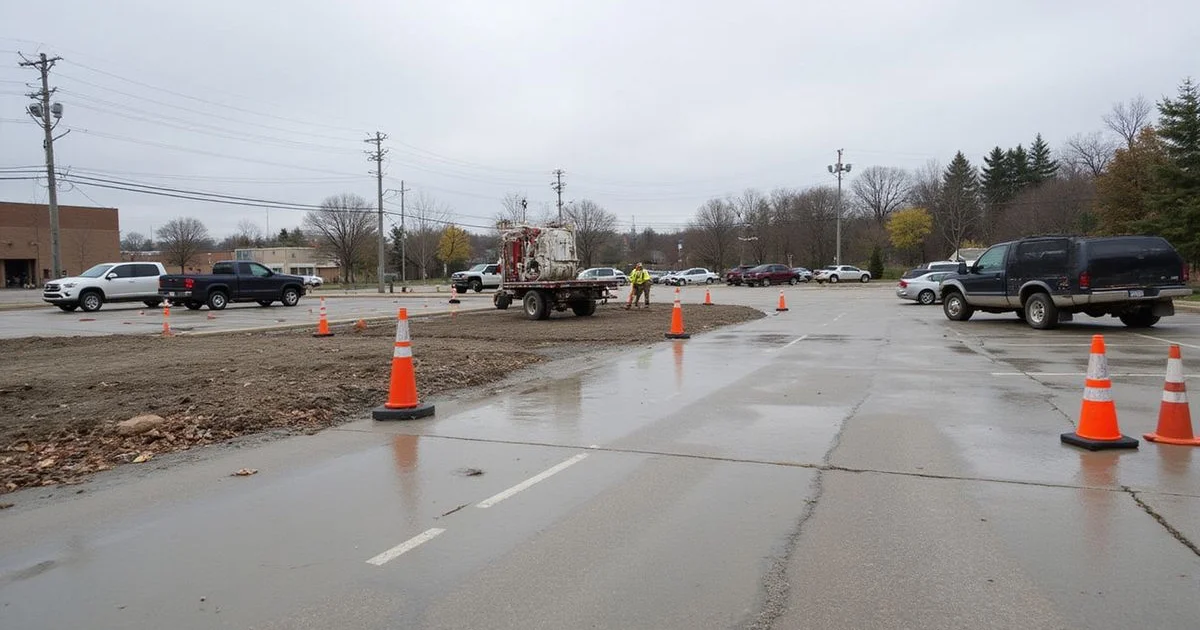
We constantly hear from local property managers who are shocked by the true financial impact of concrete work. For commercial property, the right way to compare commercial concrete leveling vs replacement is total cost of ownership. This complete calculation includes the direct job cost, facility downtime, and lost productivity.
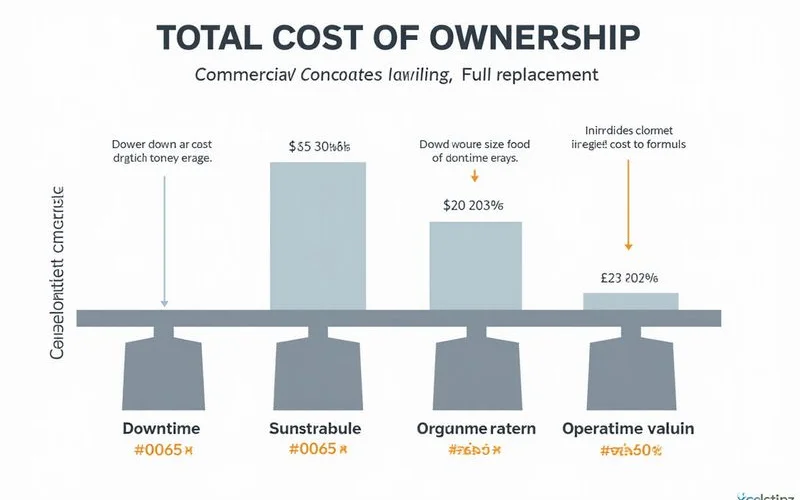
Our experience at Concrete Leveling Detroit shows that closing a parking lot or loading dock hits the bottom line hard. Recent 2026 data reveals that standard commercial replacement costs hit between $6 and $15 per square foot. That figure does not even account for the revenue lost while the cement cures.
We will break down these hidden expenses and show you exactly how to evaluate your next project.
TCO breakdown
A clear financial comparison shows that concrete leveling costs significantly less than replacement because it eliminates downtime and demolition fees. Tearing out an old slab and pouring new cement triggers a cascade of secondary costs.
Our teams consistently save clients money by avoiding these expensive secondary factors. Polyurethane injection averages a fraction of the cost of a full repour. You avoid the hefty municipal permit fees required for demolition and new construction.
We complete most lifting jobs in hours instead of the weeks needed for standard rebuilds.
| Factor | Leveling | Replacement |
|---|---|---|
| Direct job cost | Lower | Higher |
| Downtime hours | Same-day | Days to weeks |
| Lost revenue / productivity | Minimal | Significant |
| Insurance impact | None | Possible during rebuild |
| Permit costs | Rare | Usually required |
| Total | Lower | Higher |
This rapid turnaround completely erases the financial drain of lost operational time. A standard concrete pour requires 24 to 48 hours just for the initial cure before light foot traffic can resume.
Our high-density foam reaches 90 percent strength in roughly 15 minutes.
Quantifying downtime
Multiply your lost transactions or paused operational hours by the total service time to calculate your true downtime cost. A 2024 industry report by The Lilly Company found that warehouse downtime costs an average of $10,000 per hour.
We see this financial drain directly when loading docks sit idle during week-long cure times. Manufacturing facilities can lose up to $20,000 every single hour a zone remains closed. Retail centers face massive drops in daily foot traffic per closed parking area.
Our commercial clients often realize the downtime cost alone exceeds the entire leveling job. Consider these common operational losses:
- Retail: lost foot traffic per closed parking zone
- Office: parking shortage during business hours
- Warehouse: shifts paused waiting for cure
- Restaurant: closed walkways at peak service
Every paused forklift or closed lane burns cash.
We help you multiply those lost hours by your average revenue to reveal the true expense.
Insurance / liability considerations
Trip hazards present a massive financial risk, and leveling immediately eliminates this liability without creating dangerous construction zones. Recent legal data shows the national average settlement for commercial premise liability cases hits $345,000.
We make sure our clients understand the difference in risk between repairing and replacing a slab. A parking lot lift vs repour decision directly impacts your ADA exposure.
A first-time ADA Title III violation can trigger a maximum civil penalty of up to $75,000.
Our fast polyurethane lifting process reduces ADA exposure the exact same day with no dangerous rebuild perimeter. Replacement eventually reduces trip hazards but significantly increases risk along construction fencing during the messy rebuild. You should always document both pre-and-post conditions for your insurance records.
We provide comprehensive before and after documentation for every commercial project. Clear photographic evidence protects your business against fraudulent slip-and-fall claims. Property managers can easily share these detailed records directly with their insurance providers.
When replacement is genuinely required
Our technicians will honestly tell you if a slab is too far gone for a lift. Certain structural failures, like deep through-cracks or severe subgrade washouts, make a full tear-out the only viable engineering solution. The American Concrete Institute guidelines indicate replacement is necessary when subgrade failure causes complete structural collapse.
We rely on these industry standards to guide our recommendations. Look for these specific scenarios where commercial concrete repair vs replace leans toward a mandatory repour:
- Heavy spalling across major slab areas exceeding 30 percent of the surface
- Structural failure featuring through-cracks across the internal reinforcement
- Municipal mandates requiring a full replacement
- Underlying drainage rebuilds required regardless of the surface condition
Leveling foam provides incredible support but cannot glue a shattered slab back together.
We recommend securing three different replacement quotes if you face these severe issues.
Multi-phase scheduling
Large commercial properties demand careful logistical planning, making fast, zone-by-zone leveling superior to weeks-long replacement phases. A traditional replacement requires shutting down half or a quarter of the lot for several weeks per phase.
Minimizing Customer Disruption
Our scheduling team designs multi-phase solutions that keep your doors open. Tearing out massive sections of cement forces customers to drive through confusing detours. Polyurethane leveling happens zone-by-zone and only takes a few hours per area.
We can complete an entire large parking facility in a matter of days. This speed is critical for high-traffic environments like grocery stores or distribution hubs. You keep traffic flowing smoothly while the repair work happens quietly in the background.
Our approach eliminates the need for expensive temporary parking leases or off-site shuttle services.
Real Metro Detroit examples
Local weather conditions severely impact maintenance, and fast leveling allows businesses to fix freeze-thaw damage without closing. Michigan’s brutal winter temperatures rapidly expand existing cracks and worsen settlement issues.
Retail and Airport Success Stories
We recently tackled a 50,000-square-foot retail parking lot leveling project right here in the metro area. The crew finished the entire job over four overnight shifts. The lot stayed open during the daytime and the total cost came in at roughly half of a replacement quote.
Our team also completed critical leveling and joint sealant work at the Detroit Metropolitan Airport pool deck in 2022. That high-security airport project finished during off-peak hours with zero terminal closures. For commercial pricing details, see commercial concrete leveling cost in Michigan and our commercial service page.
We encourage you to Request a free estimate to see how much you can save.
Common Questions
Quick answers from our Metro Detroit crew.
How do I quantify downtime cost?
Can you phase a parking lot job?
More from this topic
Cost of Commercial Concrete Leveling in Michigan
Pricing factors: square footage, slab thickness, access, after-hours premium. Typical project ranges and RFP guidance for Detroit B2B.
Parking Lot Concrete Leveling: What to Expect
Detroit parking lot leveling — pre-job assessment, traffic-control plan, lift sequence, joint sealing follow-up, post-job inspection and warranty.
Property Manager's Concrete Maintenance Checklist
Annual inspection checklist, freeze-thaw prep timing, joint reseal schedule, void inspection cadence — by property type. Free download.
Have a slab to lift? Let's take a look.
Free, no-obligation on-site estimate. If we can't fix it, you don't pay.